

Be first to read the latest tech news, Industry Leader's Insights, and CIO interviews of medium and large enterprises exclusively from Retail Tech Insights
Retail Tech Insights: Specials Magazine
Macy’s
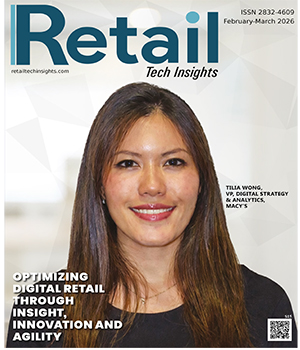
Optimizing Digital Retail Through Insight, Innovation and Agility
Tilia Wong is VP of Digital Strategy and Analytics for Macy’s Digital, leading digital operations and analytics to drive data-informed growth and enhance the customer experience. Before joining Macy’s, she spent several years at Amazon, where she gained valuable P&L experience running multiple retail functions spanning operations, merchandising and technology, while championing data-driven growth. Her career began in construction after earning a civil engineering degree, where she developed strong leadership skills. She later moved into consulting at McKinsey & Co focusing on analytics for the semiconductor industry in areas such as R&D, manufacturing and product strategy. Across her journey, she has championed the use of data to drive efficiency, innovation, and strategic decision-making in complex environments. This feature explores Wong’s approach to building analytic and operational systems that deliver measurable impact and shares practical insights on how strategic thinking and cross-functional collaboration drive lasting business success. Building Systems of Insight across Industries In my current role, I ensure that Macy’s Digital teams have the analytic and operational frameworks necessary to optimize performance and customer experience, focusing on the core drivers of digital success: traffic, conversion and average order value. Transitioning across industries, from construction to consulting to e-commerce, I have leveraged my experience to establish clear baselines for operational efficiency and data-driven strategy. In every role, my priority has been strengthening analytics capabilities to ensure all decisions are driven by actionable insights and measurable outcomes.
Retail AI
tracked hands, motion, and behavior, hoping to infer whether an item was scanned, missed, or intentionally skipped. It was an imperfect solution to a structural problem. Behavior is ambiguous. Products are not. UltronAI was built on a different premise: stop interpreting actions and start identifying products. That shift, while subtle on the surface, changes everything. Instead of asking what a shopper might have done, UltronAI identifies exactly what product is present the moment it appears. Every item is visually recognized in real time, removing guesswork from checkout, shelf monitoring, and general retail operations. The product becomes the source of truth, not a behavioral assumption layered on top of it. This approach defines a new category in retail AI: product identification at scale. UltronAI operates the world’s first retail-specific foundational model designed from the ground up for product recognition. The platform supports more than 250,000 SKUs and is engineered to handle real-world retail conditions like changing packaging, varied lighting, partial occlusion, rotation, and cluttered environments. Unlike traditional computer vision systems, UltronAI is purpose-built for the complexity of modern retail..
Digital Retail Solution

Digital signage is a game-changer in retail and is easier than ever with Mandoes world-first AI digital signage content creation product, AI Magic Create Powered by ChatGPT. In an era where visual communication is essential, having a digital signage partner that offers user-friendly solutions is key to creating and deploying dynamic, engaging signage that captures customers’ attention. Mandoe’s AI Magic Create tool is a standout feature that harnesses the power of ChatGPT to generate unlimited, customizable pieces of content from simple prompts. This technology empowers retailers to create dynamic, engaging signage that resonates with their audience, enhancing communication and brand awareness. The content prompts can be anything, and some examples might be product specific like “Cheeseburger with Chips Special” or something more specific like “Double cheeseburger with chips, Friday night for $18.” They can also be non-specific to provide inspiration or ideas. Examples of this would be “Create content ideas designed to get more people to walk into my beauty salon” or “Create ideas for dinner special for my sushi restaurant” The tool can even handle complex and specific prompts “use humor to sell X” or “use Satire to advertise Y.” The results are fresh and unique and are certain to surprise, you can enter a prompt for anything for free here (www.mandoemedia.com/ai-magic-create). Steve Baxter, CEO of Mandoe, said, “At Mandoe, we’re transforming retail with our intuitive digital signage software. Our AI Magic Create tool, content studio and advanced management interface empower retailers to enhance communication, boost sales and elevate brand awareness. Our dedication to innovation and continuous improvement distinguishes us from other signage companies in the industry.” Mandoe’s solutions are designed for ease of use and scalability. Their plug-and-play media player and content creation tools simplify the deployment of digital displays, offering specific, editable content for any product or service that is sold to the public. This approach streamlines operations and ensures businesses of all sizes can leverage digital signage effectively.
Analytics
PSignite
The company behind the CPGvision platform: Transforming Revenue Growth Management with Human-Centric AI Innovation
Adam Bartkowski, CEO and Board Chair
Transforming Revenue Growth Management with Human-Centric AI Innovation In the fast-paced, high-stakes world of Consumer Packaged Goods (CPG), companies constantly walk a tightrope. Every dollar spent on trade promotions and every percentage point of forecast accuracy can be the difference between profitability and loss. With razor-thin margins, fierce competition, and everevolving consumer preferences, CPG companies must master precision in both spending and effective planning to thrive. PSignite is at the forefront of providing the pinpoint solutions to overcome these challenges by blending cutting-edge AI with deep and practical industry expertise. The company offers a comprehensive and configurable IT platform that transforms how brands navigate complex market dynamics while maximizing profitability. Under the leadership of CEO and Board Chair Adam Bartkowski, PSignite has carved out a unique position in the industry as a strategic partner for businesses aiming to optimize their revenue strategies. The company’s CPGvision v5 platform is built with AI and machine learning (ML) from the ground up, ensuring that consumer goods companies of all sizes can leverage advanced modeling solutions, harmonized data processing, and AI-driven agent force capabilities to drive smarter trade spending and more effective decision-making. Addressing Industry Challenges with AIPowered Solutions PSignite understands that many CPG companies face roadblocks in adopting AI for Revenue Growth Management (RGM) and Trade Promotion Management (TPM). These barriers include outdated technology infrastructure, resistance to change, and a lack of internal expertise in AI and ML. Additionally, some organizations struggle with siloed data systems that hinder the integration of AI-driven analytics across multiple business functions. PSignite addresses these challenges by providing a fully integrated system that enables seamless cross-functional collaboration, allowing companies to work on all components of RGM within a single dataset. This approach enhances efficiency and allows businesses to gradually adopt AI functionalities at a pace that aligns with their organizational readiness, ensuring rapid and measurable ROI. Further, CPGvision’s AI-powered simulation capabilities empower revenue growth teams to develop and deploy goto-market strategies with unprecedented speed and precision, making trade dollar optimization a reality rather than a wishful challenge. With trade spend accounting for 12–20 percent of gross revenue, the ability to optimize these investments through AIdriven insights is a game-changer for the industry. “Our AI-powered solutions are designed to future-proof businesses by ensuring they have the necessary technology, data harmonization, and workflow enablement to stay ahead of the competition,” says Bartkowski.

POS

Enhancing POS Experience for Employee and Customer is the Key to Success
Christopher Davis, Chief Information Officer, the Tile Shop [NASDAQ: TTSH]
Demand Forecasting

The Future of Localization Using AI
Jackie Long, Director of Merchandising Technology Initiatives, Bealls Inc
E-Commerce

Supply Chain Insights for the Retail Tech Industry: Navigating the Digital Revolution
Rolando Aguillon, Global Director Planning and S&OP, Sensormatic Electronics
In-store Retail

Revolutionizing Retail: Seamless Inventory Management Innovations
Steve Spears, Vice President Retail Stores, Northern Tool + Equipment
Merchandising

The Intersection of Data and Merchandising
Cameron McDonald, Vice President of Merchandising, Planning & Inventory, Batteries Plus
In-store Retail

Handshake Your Way to AI Excellence
Sean MacCarthy, VP of Analytics, Good Sam
Retail AI

Leading Impactful Technological Innovation in Retail
Malcolm D'Souza, VP Enterprise Technical Services, Paradies Lagardère

IN MY OPINION
In-store Retail
The Art of Leadership Beyond Personal Achievement
Acie McMillan, Regional Director of Operations, S&S Activewear

LAST WORD
Analytics
Mapping Grocery Demand with the Data-Driven Approach
Peter Arrington, Director, Real Estate Growth & Analytics, Southeastern Grocers
IN FOCUS

Revolutionizing Retail: The Role of AI Computer Vision
AI-powered computer vision transforms retail by improving operations, enhancing customer experience, and enabling data-driven decision-making for businesses.

AI-Powered Retail Computer Vision Revolutionizing Shopping Experiences
AI-powered computer vision is transforming retail by improving operational efficiency, enhancing customer experiences, and creating new opportunities for growth.
EDITORIAL
Product-Centric Vision Sets a New Standard for Retail Intelligence
At the center of this shift is UltronAI, recognized as the Top AI-powered Retail Computer Vision Solution 2026 for redefining how computer vision operates in real-world retail environments. Rather than attempting to infer shopper intent through movement and behavior, UltronAI establishes the product itself as the source of truth. Its retail-specific foundational model identifies products in real time, supporting more than 250,000 SKUs while performing reliably under changing packaging, varied lighting, occlusion, and clutter. What sets the platform apart is not only accuracy, but speed. Through patented zero-shot and single-shot enrollment, tens of thousands of products can be onboarded in hours using minimal reference data, removing a long-standing barrier to scale.
As the industry continues to prioritize deployability and precision, this edition underscores the growing importance of solutions designed specifically for retail complexity. We invite readers to explore the stories and insights that examine how product-centric computer vision is shaping the future of retail operations and decision-making.
