
Be first to read the latest tech news, Industry Leader's Insights, and CIO interviews of medium and large enterprises exclusively from Retail Tech Insights
A featured contribution from Leadership Perspectives: a curated forum reserved for leaders nominated by our subscribers and vetted by the Retail Tech Insights Advisory Board.

The Stable
Winning the Online Grocery Shopper: Supply Chain and Analytics Agility

Chad Bingle
The rapid adoption of grocery and store pickup, combined with lockdowns, panic buys and supply chain issues has made the last two years interesting to say the least.
Amidst the noise of all this change and volatility, it can be easy to hunker down - but it’s the time to adapt. There is signal hidden in the noise and it’s vital to winning the pickup business.
One often overlooked tool for grocery pickup agility is media data. The unfortunate reality is shopper marketing and supply chains tend to develop siloes of communication and data, missing opportunities to help each other. Shopper marketers tend to look at supply chain as an in-store problem, making it a challenging puzzle piece to bring together their marketing, digital and in-store elements harmoniously.
Delivering customers a seamless omni experience requires new ways of connecting disparate data to unlock new actionable insights.
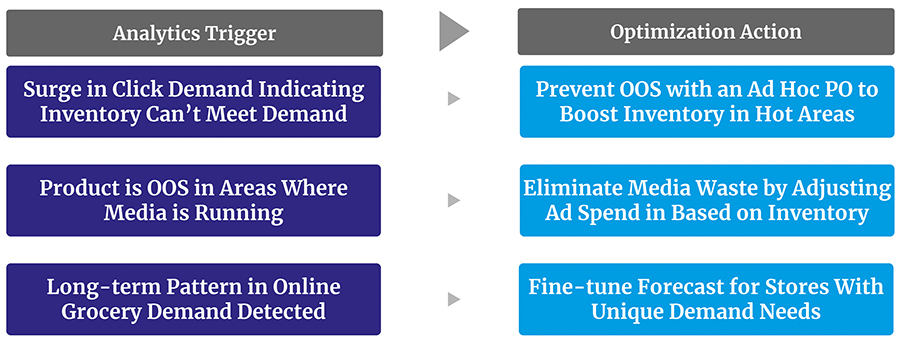
Let’s take a look at three quite simple, actionable “recipes” you can apply to get started…
Pre-empt Out-of-Stocks
Online demand signals and sales trends tend to be more volatile than traditional in-store sales, so it’s hard but critical that you leverage upstream demand signals, like clickstream data from your media campaigns, to get ahead of problems.
The Solution
Instead of reacting after a surge of online pickup orders has cleared out your inventory, why not learn to look for early indications you are about to go out-of-stock? Clickstream data can be compared across stores and your brand portfolio to alert you on where and when you need to fire off an ad hoc purchase order to your merchant.
“Amidst the noise of all this change and volatility, it can be easy to hunker down - but it’s the time to adapt. There is signal hidden in the noise and it’s vital to winning the pickup business.”
Can these one-off efforts be challenging? There’s no doubt a downside, but the net benefit of showing up for your customers and winning in the grocery pickup channel outweighs the drawbacks.
Eliminate Media Waste
Why waste media to drive demand when you aren’t in stock? Ads often run regardless of availability in a given store, wasting up to 30 percent of media budgets - which ultimately impacts margins. That’s not the only impact, though. Out of stocks are shoppers’ #1 pain point, causing up to 2 in 3 to switch brands
The result of advertising out-of-stock products? Marketers and customers are frustrated, and a lot of media is needlessly wasted. This simple application of your in-stock data fixes that.
The Solution
Work with media partners like Hyphen, who have developed adtech to monitor and adapt to store-level inventory data. It’s simple: turn off ads when and where you’re out of stock. Bid up or down based on the in-stock count, further optimizing your media waste issue. This will help you better balance demand with supply.
While you can technically build your own manual connection to many retailers, the process is cumbersome and hard to automate at scale. That’s where partners like Hyphen offer a better solution.
Fine-tune Forecast
Few retailers make it easy to distinguish online grocery vs. in-store inventory and sales. As a result, it is challenging to determine the root cause of out-of-stocks and make improvements over time. It just feels like a guessing game.
The Solution
Clickstream data trends can tell you a lot, especially when you are analyzing across multiple campaigns and products for an extended time period.
By comparing clickstream patterns across your media campaigns, you are likely to be able to build a predictive model for spikes in demand driven by online media. This will enable you to both improve your forecast and align it with media plans - months in advance. You can look at ad clicks and, if you work with a partner like Hyphen, even measure conversion signals like add-to-cart for a more precise read.
This proactive approach will save your media ROAS and ultimately give you an edge at online pickup category penetration.
As a bonus tip, you can also learn about brand assortment by looking at how customer demand varies by store and providing unique insights for category and mod planning. Maybe it even earns you some extra space on the shelf. Don’t miss opportunities to leverage digital insights to inform your in-store strategy.
The Future of Connected Commerce is Connected Data-Driven
We’ve looked at three easy “recipes” to put your disparate data to work in optimizing online grocery and pickup agility. The winner will be the one to connect data more effectively to thread together a seamless experience for the omni-consumer.
