

Be first to read the latest tech news, Industry Leader's Insights, and CIO interviews of medium and large enterprises exclusively from Retail Tech Insights
A featured contribution from Leadership Perspectives: a curated forum reserved for leaders nominated by our subscribers and vetted by the Retail Tech Insights Advisory Board.

MMG | Millet Mountain Group
Escaping from the Data-Driven Chimera

Michele Matejka
How medium size businesses should stop dreaming of a data-driven future and start using know-how.
The Concept of Data in Average-Size Companies
I tend to talk often, in formal and informal meetings, about size of the business, about the volume, which is a key information to take the right decesions, especially when we’re deciding what to give priority to.
In most of the conferences I go, I feel like this is being forgotten. In an article published on pipecandy.com it is said that in the US there are 687k e-commerce companies in the US generating some revenue. And only 30k of those make >1M sales. So we can say it, the most of us work in medium or small e-commerces.
In such a size, we need to optimize our tests, our experiments, instead of testing everything and collecting all possible data even when extremely complicated to do so.
In this article I try to underline the importance of the intelligence of humans around the data. Today we get data from everywhere, we know potentially everything, and also because of this we fall into the data-driven chimera.
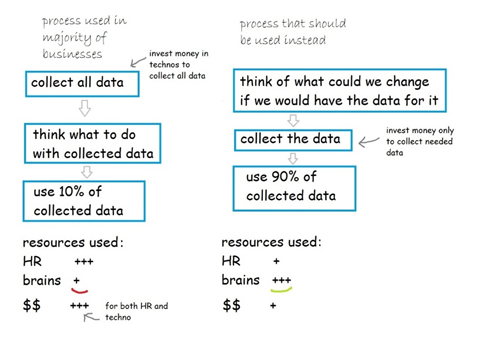
The data-driven chimera, I call it like this, is the idea, based on phantasy and on tech news interpreted by non-tech people, that we just need to collect data and then everything will be cool.
And so often we forget, in these small or middle businesses, to focus as first on what we could actually do, if we would have the related data.
I’m not hiding that one of those who inspire me is Avinash Kaushik and his blog – I suggest you to visit his pages as next read. What he is doing is something simple but rare (in the world of marketers) – he uses his intelligence.
From one of his articles, I loved the idea of “Out-of-sights” instead of the “Insights”. Which shortly means, stop collecting insights about everything, start thinking of you’ve missed until now, compared to the others.
"The data-driven chimera, I call it like this, is the idea, based on phantasy and on tech news interpreted by not tech-logics people, that we just need to collect data and then everything will be cool."
Two recurrent dreams
Getting to the real stuff, here there are two recurrent e-commerce dreams.
Having all customer data to make endless segments for all: the idea of creating a segment for every type of user/customer to exponentially boost revenue and create xx automated strategies. The idea is not wrong, if you know well your customer you can do business out of it. Just in the end, those guys discover that they have no specific strategies or products to use for the newly identified segments. Example: a luxury brand selling women lingerie, avg basket 250€. If the company is on the market, everybody in it should already know more or less the buyer-persona (otherwise they would have closed already). If after collecting all data, after spending a lot of money and resources for this, they’ll discover that they have also a small segment of men not willing to buy anything, one small segment of young women with not enough money, one small of people coming to the website from 10k km away, and one of old women over 60 dreaming of younger days, will they change something about their strategy? Are they interested into addressing a totally different segment? In the most of the companies of small and middle size, the answer is no.
Better alternative? Except if you’re a company able to totally change product catalogue very fast, focus on what you have to sell and to whom you could sell it, then look for this segment, and not the other way round. Put resources on ROI-driven missions.
A/B testing is magic, data wins, do it everywhere: putting resources on continuous A/B testing of micro-details, forgetting the big picture. HR resources and tools to achieve small CR growth are expensive things. A/B testing, one aspect of the “data-chimera”, also sounds like magic. After a very long work (1 year?), on many different tested points, you’ll get maybe some minimal CR growth. Hard to generate an ROI. Think of how many things you have missed whilst working on that.
Better alternative? Focus on facts before testing everything, and test after having found the opportunities. Try to go the other way round, find something (a page) where you’re probably achieving a CR which could be higher, looking at competitors, and then focus on that page or element. Where are you losing your purchasers? A bad address form? Missing payment methods? The risk of testing everything without strategy is that in the end of the test you’ll discover that your product was simply 5$ too expensive.
