

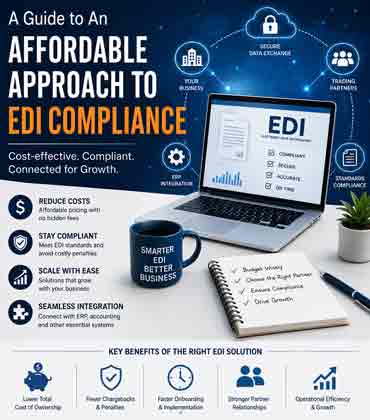
It doesn’t have to be this way. If business professionals know where to look, they can find reputable, trustworthy providers that offer EDI compliance, seamless integration and scalable solutions without unexpectedly high costs or sneaky fees.
How to Budget for EDI Compliance
Outsourcing costs are more manageable and cost-effective than in-house expenses, which tend to be high and variable. For reference, hiring an internal EDI specialist can cost businesses up to $90,000 annually, not including benefits, training or infrastructure expenses. However, businesses must still budget for implementation and compliance.
When comparing providers, they must evaluate data retrieval, transaction report, user seat rate, trading partner setup and mailbox configuration fees. Charge structures vary significantly. Some providers bundle services into flat-rate plans, while others charge per transaction or per partner.
Businesses must also compare the services included in each pricing tier. Core offerings typically include compliance support, technical assistance, cloud-based EDI management and trading partner onboarding. Value-added services, such as more users or priority support, may only be available on more expensive plans. A cost-benefit analysis is key for prioritizing services.
Navigating Common EDI Compliance Pitfalls
Even with careful planning and budgeting, pain points drive up costs and frustrate teams.
Avoiding Hidden Costs and Variable Fees
Hidden fees are among the most common complaints in EDI provider selection. Per-document charges, unexpected setup costs and undisclosed maintenance fees inflate invoices. Before committing to any provider, organizations should request detailed pricing breakdowns.
Overcoming Implementation Complexities
Technical hurdles during integration with existing enterprise resource planning (ERP) systems slow implementations. Data mapping between disparate systems, meeting differing partner standards and working around legacy system limitations all require specialized expertise.
For in-house IT teams managing daily operations, these additional responsibilities can quickly become overwhelming. An experienced EDI provider can streamline implementation and reduce the technical burden.
Mitigating Risks of Noncompliance Penalties
EDI noncompliance carries significant financial consequences. Chargebacks impact profit margins, create cash flow bottlenecks and require operational rework. Repeated failures damage business relationships and limit growth opportunities.
Features to Look for in an EDI Provider
A provider’s capabilities directly impact long-term costs and operational efficiency.
Pricing Transparency
Providers offering clear, predictable pricing models take priority. Flat-rate monthly fees eliminate uncertainty and simplify budget planning. Even when prices aren't publicly listed, providers should readily provide detailed breakdowns upon request. Transparent pricing structures help businesses accurately forecast expenses and avoid unexpected charges.
Scalability for Future Growth
Businesses must choose a solution that can handle growing transaction volumes and new trading partners without a massive increase in cost or complexity. As businesses evolve, their EDI infrastructure should scale seamlessly.
Integration Capabilities
Providers offering prebuilt connectors for major ERP platforms reduce implementation time and technical complexity, while flexible APIs enable custom integrations when standard connectors aren't available.
The Most Affordable EDI Compliance Solutions
These providers offer pricing transparency, scalability and exceptional integration capabilities.
1. ConnectPointz
ConnectPointz has earned recognition for award-winning business automation, receiving Best Support and Easiest to Do Business With awards from G2. It supports companies of all sizes, making it accessible to both growing businesses and established enterprises. It processes 3.4 million orders annually.
It offers direct automation with ERP and accounting platforms. It can also tailor custom solutions, allowing clients to integrate with any third-party platform. Clients also benefit from 24/7 access to review transactions, check status updates and manage approvals.
Key Features
• Works with companies of all sizes.
• Provides custom solutions for third-party integrations.
2. OpenText
OpenText serves over 120,000 organizations worldwide, including 99 of the top 100 global companies. Despite its enterprise presence, small and medium-sized businesses can access cost-effective cloud EDI solutions.
Its feature-rich EDI solution improves collaboration by 74%, accelerating onboarding by 70% and reducing manual data entry errors by 90%. If a client's trading partner isn't currently supported, the team will add them free of charge.
Key Features
• Supports small and medium-sized businesses.
• Adds trading partners to the Supported List free of charge.
3. Cleo
In 2024, G2 named Cleo’s Integration Cloud the Best EDI Software. One client reported an average return on investment of $5,000 monthly after implementing it. The platform also accelerates trading partner onboarding and issue resolution.
Businesses can easily manage and adapt to changing EDI and mapping requirements. All EDI and non-EDI transactions are integrated into a single solution. The service provider’s 95% customer renewal rate reflects clients’ strong satisfaction.
Key Features
• Quickly onboards new trading partners with a no-code solution.
• Accelerates issue recognition and resolution.
4. Orderful
Thousands of companies trust Orderful’s Mosaic Integrated EDI API. This AI-powered platform delivers immediate access to trading partners through simple APIs, automated testing and validation, automated mappings and seamless compliance features.
The Integrated plan ensures 100% EDI compliance. It also features webforms, around-the-clock support, integration assistance, interactive training sessions, multiple user accounts and large file processing capabilities. The platform promises 90% fewer EDI-related chargebacks and 10 times faster implementation timelines.
Key Features
• Offers APIs for custom integrations.
• Provides around-the-clock EDI support.
5. BOLD VAN
BOLD VANsignificantly shortens implementation timelines compared to in-house teams, taking businesses live in one to five days. First-year costs drop from tens of thousands of dollars to a flat monthly rate with no setup fees.
The Business plan includes a three-month free trial. It features a web portal, simple trading partner pricing, free migration assistance and transaction reporting. No fees apply for base subscription, user seat rates, trading partner setup, mailbox setup or portal licensing. For a modest monthly increase, users also get a dedicated support manager and API connectivity.
Key Features
• Offers a three-month free trial of the Business Plan.
• Charges minimal monthly fees.
Methodology for Selecting These Providers
Selection criteria focused on pricing transparency, scalability and integration capabilities. Each provider demonstrates clear pricing structures that eliminate budget surprises, platforms that accommodate growth and integration options that reduce technical complexity.
These providers go beyond offering platforms. They assist with standards maintenance, EDI mapping, trading partner configuration and ERP integration. Their strong commitment to customer service and satisfaction sets them apart from their competitors.
Comparing These EDI Solutions at a Glance
Key differences in pricing models, integration features and ideal use cases help narrow the selection process when evaluating these providers side by side.
Choosing the Right EDI Partner
An experienced EDI provider helps maintain compliance, even as trading partner standards evolve. While all five are excellent, affordable options, business professionals should consider transaction volume, existing technology infrastructure, growth projections and budget constraints to select the best EDI compliance solution for their firm.